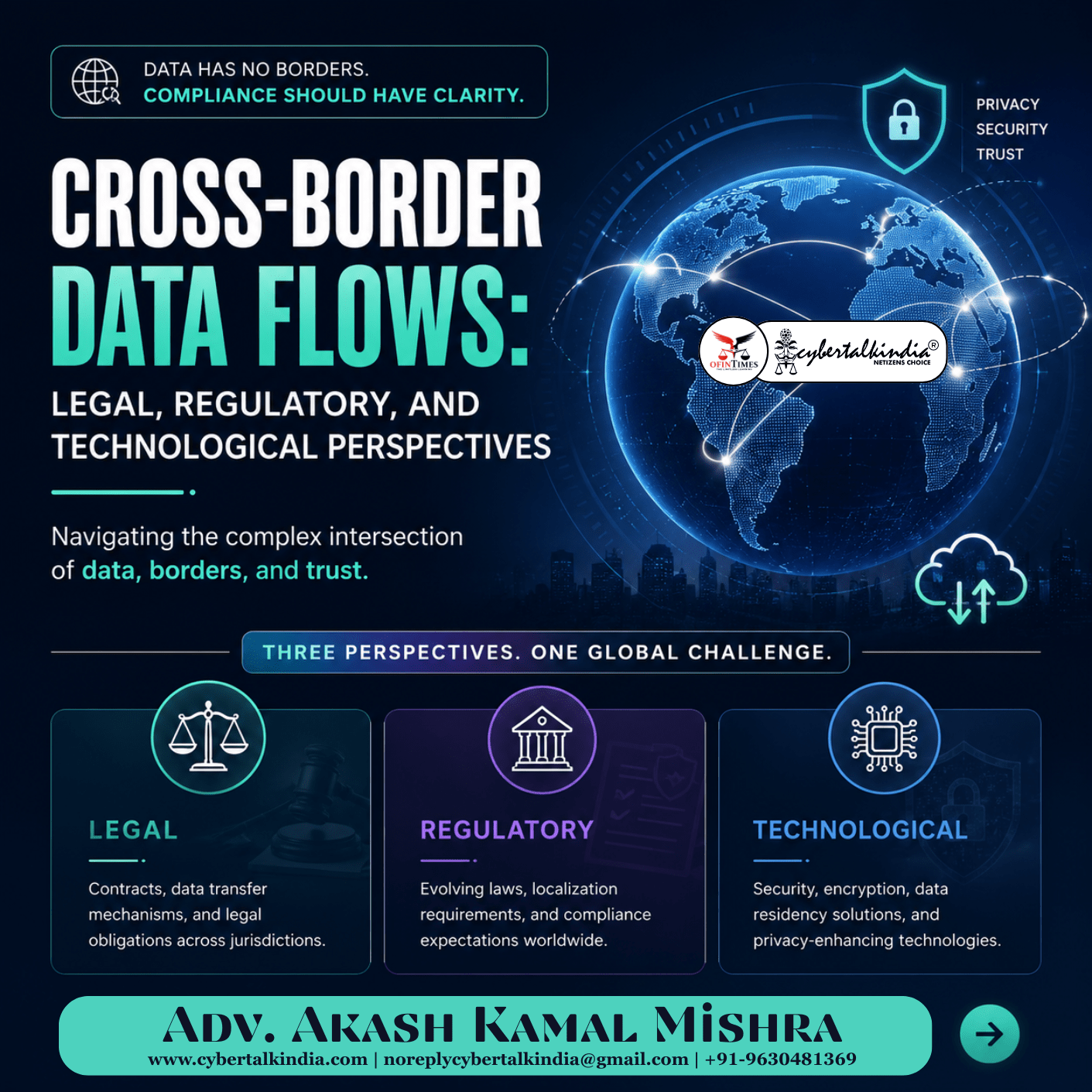
Cross-Border Data Flows: Legal, Regulatory, and Technological Perspectives
- Introduction
In the contemporary digital economy, data has emerged as one of the most valuable assets, often referred to as the “new oil” of the twenty-first century. Every day, billions of individuals, businesses, governments, and organizations exchange information through digital networks that transcend geographical boundaries. Whether through cloud computing, social media platforms, e-commerce transactions, financial services, online education, healthcare systems, or international business operations, data constantly moves across national borders. This movement of information from one country to another is commonly known as cross-border data flow.
Cross-border data flows have become the backbone of globalization and digital transformation. They facilitate international trade, enhance innovation, enable global collaboration, support multinational business operations, and provide seamless digital services to users worldwide. However, the increasing volume of international data transfers has also raised concerns regarding privacy protection, data security, cybersecurity threats, national sovereignty, surveillance, and regulatory compliance. As a result, governments around the world have developed legal frameworks to regulate the transfer of personal and sensitive information beyond their territorial jurisdictions.
The regulation of cross-border data flows represents one of the most challenging areas of modern cyber law and data protection law. Policymakers seek to balance economic growth and technological innovation with the protection of individual privacy rights and national interests.
- Understanding Cross-Border Data Flows
Cross-border data flows refer to the transfer, storage, processing, or access of data across international borders. Such transfers may occur intentionally or automatically as part of digital infrastructure operations.
Examples of cross-border data transfers include:
- An Indian user storing files on a cloud server located in Singapore.
- A multinational corporation processing employee information in different countries.
- An e-commerce company transferring customer data to overseas analytics providers.
- A social media platform storing user information in global data centers.
- International financial institutions exchanging transaction records.
- Healthcare organizations sharing medical data for research purposes.
Modern digital services often rely on globally distributed data centers and cloud infrastructure. Consequently, even routine online activities may involve data transfers across multiple jurisdictions without the user being aware of them.
- Importance of Cross-Border Data Flows
Cross-border data flows play a critical role in supporting the digital economy and global commerce. Their significance extends across various sectors.
- Economic Growth: International data transfers enable businesses to operate efficiently across multiple markets. Global companies can centralize operations, manage supply chains, conduct market analysis, and deliver services to customers worldwide.
- Innovation and Technology Development: Artificial Intelligence (AI), machine learning, big data analytics, and cloud computing rely heavily on access to large and diverse datasets. Cross-border data flows facilitate technological advancements by allowing organizations to process information from multiple regions.
- Global Trade and E-Commerce: Digital trade depends on the seamless movement of information. Cross-border data transfers support online transactions, payment processing, logistics management, customer support, and fraud detection systems.
- Financial Services: Banks, payment gateways, insurance companies, and financial institutions routinely exchange data internationally to process transactions, assess risks, prevent money laundering, and comply with regulatory requirements.
- Research and Development: Scientific collaboration, medical research, educational partnerships, and innovation ecosystems depend on international data sharing. Cross-border data transfers contribute significantly to advancements in healthcare, climate research, and technological development.
- Legal Challenges Associated with Cross-Border Data Flows
Despite their benefits, international data transfers raise complex legal and regulatory concerns.
- Privacy Protection: Different countries maintain varying standards of privacy protection. Data transferred from a country with strong privacy laws to a country with weaker protections may expose individuals to greater privacy risks.
- Jurisdictional Conflicts: When data is stored or processed in another country, determining which nation’s laws apply becomes complicated. Multiple jurisdictions may claim authority over the same dataset.
- Government Surveillance: Cross-border data transfers may expose information to foreign government access requests, intelligence gathering activities, or national security investigations.
- Cybersecurity Risks: International data movement increases exposure to cyber threats such as hacking, ransomware attacks, unauthorized access, and data breaches.
- Regulatory Compliance: Organizations must comply with multiple legal frameworks governing data transfers. Failure to meet regulatory requirements can result in substantial penalties, reputational damage, and legal liability.
- Global Regulatory Approaches to Cross-Border Data Flows
Countries have adopted different approaches to regulating international data transfers.
- Free Flow of Data Model: Some jurisdictions support the unrestricted movement of data across borders, provided adequate security measures are implemented. This model promotes innovation, competition, and economic growth.
- Adequacy-Based Model: Certain legal systems permit data transfers only to countries that provide an adequate level of data protection comparable to domestic standards.
- Data Localization Model: Some countries require specific categories of data to be stored within national borders. Data localization seeks to enhance sovereignty, improve regulatory control, and strengthen national security.
- Hybrid Approach: Many countries adopt a balanced approach by allowing international transfers under specific conditions while imposing restrictions on sensitive or critical data categories.
- Cross-Border Data Transfers under the European Union GDPR
The European Union’s General Data Protection Regulation (GDPR) is widely regarded as one of the most influential data protection frameworks globally.
Under GDPR, personal data may be transferred outside the European Economic Area only when adequate safeguards are in place.
Mechanisms facilitating lawful transfers include:
- Adequacy Decisions
- Standard Contractual Clauses (SCCs)
- Binding Corporate Rules (BCRs)
- Approved Codes of Conduct
- Explicit Consent of Data Subjects
GDPR emphasizes accountability, transparency, and protection of fundamental privacy rights throughout the data transfer process.
- Cross-Border Data Flows under Indian Law
India has emerged as one of the world’s largest digital economies, making cross-border data governance a significant policy concern.
Historically, cross-border data transfers were regulated primarily through the Information Technology Act, 2000 and associated rules. However, India has recently strengthened its data protection framework through the enactment of the Digital Personal Data Protection Act, 2023 (DPDP Act).
The DPDP Act adopts a relatively flexible approach to international data transfers. Instead of imposing blanket localization requirements, the law permits transfers of personal data to countries or territories notified by the Central Government. The government retains authority to restrict transfers to specific jurisdictions if deemed necessary.
This framework aims to balance privacy protection, economic growth, digital innovation, and international business operations while ensuring regulatory oversight over data movement.
- Data Localization and Data Sovereignty
The concepts of data localization and data sovereignty have become increasingly prominent in international policy discussions.
- Data Localization
Data localization refers to legal requirements mandating that certain data be stored, processed, or maintained within a country’s borders.
Proponents argue that localization:
- Enhances national security.
- Facilitates law enforcement access.
- Protects citizens’ privacy.
- Strengthens digital sovereignty.
Critics contend that localization:
- Increases operational costs.
- Reduces efficiency.
- Limits innovation.
- Restricts international trade.
- Data Sovereignty
Data sovereignty emphasizes that data should remain subject to the laws of the country where it originates. This principle seeks to ensure governmental control over data generated by citizens and organizations within national territory.
- Role of International Agreements
International agreements and trade frameworks increasingly address cross-border data transfers.
Several trade agreements include provisions promoting trusted data flows while preserving regulatory autonomy. These agreements seek to reduce barriers to digital trade and encourage interoperability among legal systems.
International organizations continue to develop standards and principles supporting secure and lawful data transfers across jurisdictions.
- Cross-Border Data Flows and Cloud Computing
Cloud computing has significantly transformed global data management practices. Most cloud service providers operate data centers distributed across multiple countries.
Cloud infrastructure enables:
- Scalability
- Cost efficiency
- Remote accessibility
- Disaster recovery
- Global service delivery
However, cloud-based data transfers require organizations to carefully assess:
- Data storage locations
- Transfer mechanisms
- Security safeguards
- Contractual obligations
- Regulatory compliance requirements
Organizations must ensure that cloud providers implement adequate technical and organizational measures to protect transferred data.
- Emerging Technologies and Future Challenges
The future of cross-border data flows will be shaped by emerging technologies and evolving regulatory frameworks.
- Artificial Intelligence: AI systems require large datasets from multiple jurisdictions. Regulators face challenges in balancing innovation with privacy and ethical concerns.
- Internet of Things (IoT): Connected devices continuously generate and transmit data across international networks, creating new compliance and security challenges.
- Blockchain Technology: Blockchain systems distribute data across multiple nodes globally, complicating jurisdictional control and regulatory oversight.
- Quantum Computing: Future quantum technologies may transform encryption standards, requiring new approaches to securing international data transfers.
- Digital Sovereignty Movements: Governments worldwide are increasingly emphasizing digital sovereignty, which may lead to stricter controls over cross-border data movement.
- Best Practices for Organizations
Organizations engaged in international data transfers should adopt comprehensive compliance strategies.
Key measures include:
- Conducting transfer impact assessments.
- Implementing strong encryption mechanisms.
- Using contractual safeguards.
- Maintaining transparency with data subjects.
- Monitoring regulatory developments.
- Establishing incident response procedures.
- Performing regular compliance audits.
- Adopting privacy-by-design principles.
These measures help mitigate legal, operational, and cybersecurity risks associated with cross-border data transfers.
- Conclusion
Cross-border data flows have become indispensable to the functioning of the global digital economy. They facilitate international trade, technological innovation, financial transactions, cloud computing, research collaboration, and digital service delivery. At the same time, the unrestricted movement of data raises significant concerns relating to privacy, security, jurisdiction, surveillance, and national sovereignty.
As countries continue to develop and refine their data protection laws, organizations must navigate an increasingly complex regulatory landscape governing international data transfers. Frameworks such as the European Union’s GDPR and India’s Digital Personal Data Protection Act, 2023 illustrate evolving approaches toward balancing economic interests with privacy rights and national security objectives.
The future of cross-border data governance will depend on international cooperation, harmonized legal standards, robust cybersecurity measures, and responsible technological innovation. Achieving an appropriate balance between data mobility and data protection will remain one of the most important legal and policy challenges of the digital age.
Tags:
#crossborderdataflows #dataprivacy #dataprotection #cyberlaw #cyberlawindia #dpdpact #gdpr #digitalprivacy #datagovernance #informationtechnologylaw #cybersecurity #privacylaw #digitalrights #technologylaw #datasecurity #cloudcomputing #artificialintelligence #digitaleconomy #internationallaw #lawstudents #legalresearch #cybertalkindia #cyberawareness #digitalindia #legaleducation #internetgovernance #datalocalization #datasovereignty #compliance #techlaw #akashkamalmishra