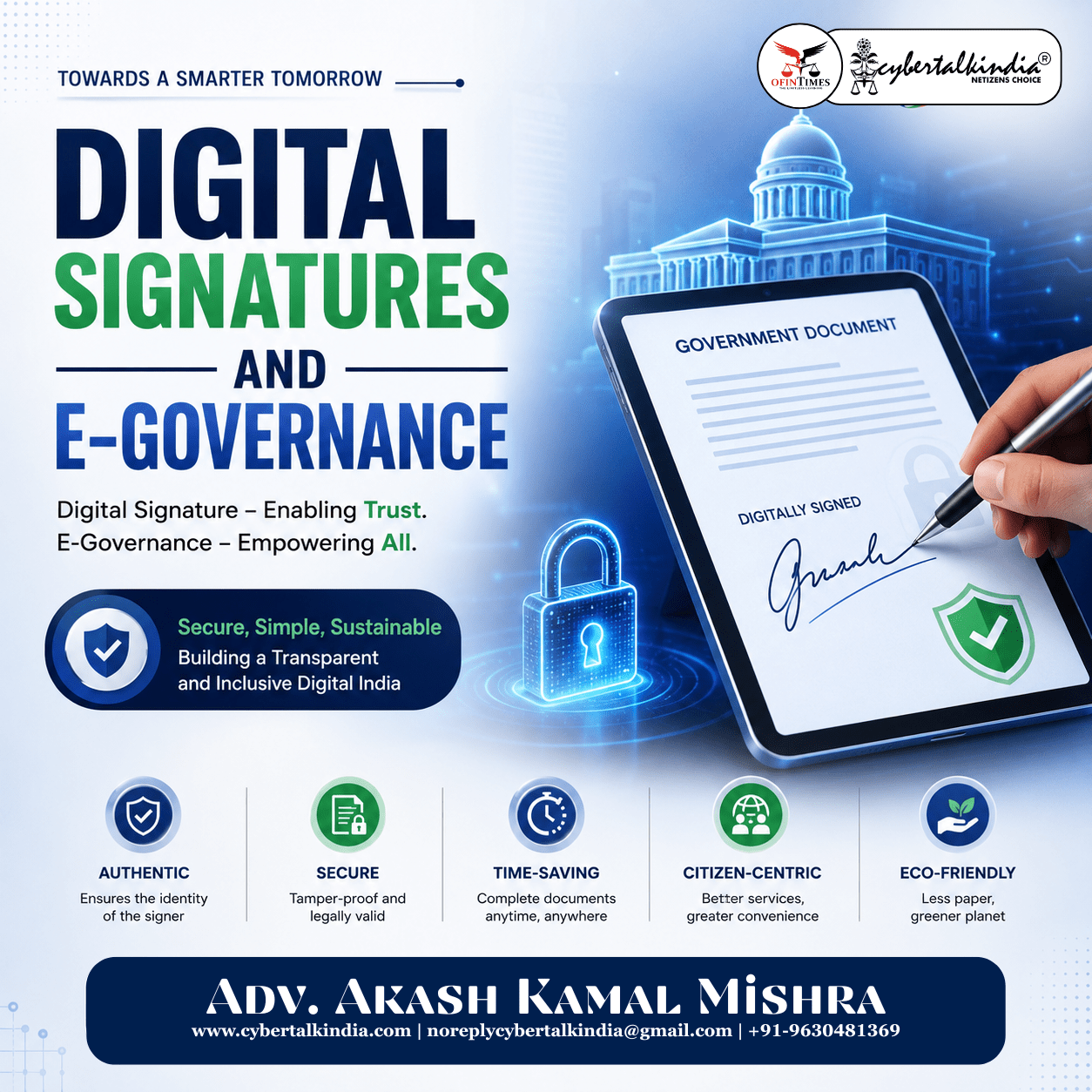
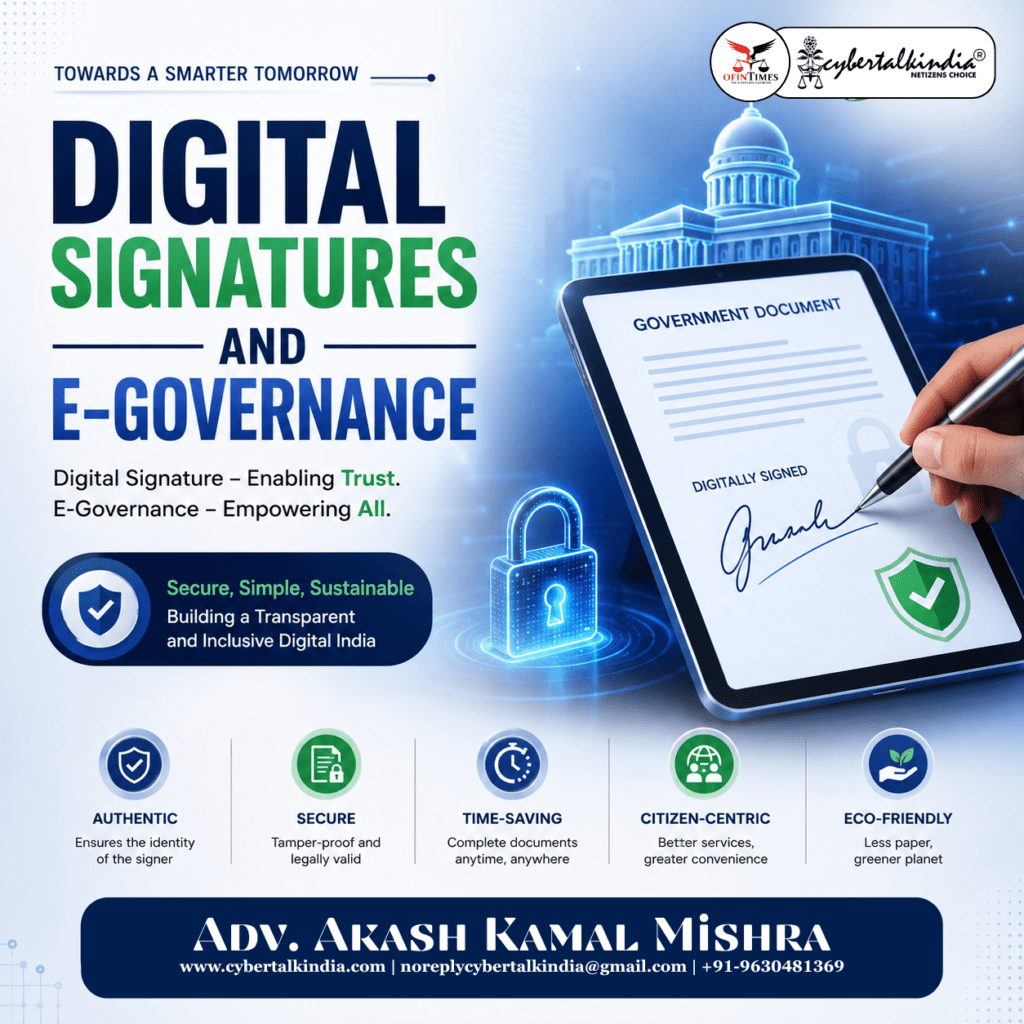
Digital Signatures and E-Governance
- Introduction
The rapid growth of information and communication technology has transformed the manner in which governments, businesses, and individuals interact with one another. Traditional paper-based administration is increasingly being replaced by electronic systems that enable faster, more efficient, and transparent delivery of services. In this digital ecosystem, the concepts of Digital Signatures and E-Governance have emerged as essential components of modern governance. Digital signatures provide authenticity, integrity, and security to electronic transactions, while e-governance utilizes digital technologies to improve public administration and citizen services. Together, these innovations have revolutionized governmental operations, enhanced public trust, and facilitated the transition towards a digitally empowered society.
In India, the legal recognition of digital signatures under the Information Technology Act, 2000 has played a significant role in promoting electronic transactions and supporting various e-governance initiatives. The government’s vision of Digital India has further accelerated the adoption of digital technologies, making digital signatures an indispensable tool for secure online communication and governance.
- Meaning and Concept of Digital Signatures
A Digital Signature is an electronic authentication technique used to verify the authenticity and integrity of electronic documents, messages, and transactions. It functions as a virtual equivalent of a handwritten signature but offers a significantly higher level of security. Digital signatures are based on cryptographic technology, particularly Public Key Infrastructure (PKI), which utilizes a pair of cryptographic keys—a private key and a public key.
When a person digitally signs a document, the private key is used to create a unique encrypted code associated with the document. The recipient can verify the authenticity of the signature using the corresponding public key. If any alteration is made to the document after signing, the digital signature becomes invalid, thereby ensuring data integrity.
Unlike ordinary electronic signatures, digital signatures employ sophisticated encryption techniques that make forgery extremely difficult. As a result, they are widely used in legal, commercial, governmental, and financial transactions.
- Legal Recognition of Digital Signatures in India
The legal framework governing digital signatures in India is primarily contained in the Information Technology Act, 2000. The Act was enacted to facilitate electronic commerce and provide legal recognition to electronic records and digital signatures.
Section 3 of the Information Technology Act, 2000 recognizes digital signatures based on asymmetric cryptosystems and hash functions. The Act provides that where any law requires a signature, such requirement shall be deemed satisfied if a digital signature is affixed in accordance with the provisions of the Act.
The Information Technology (Amendment) Act, 2008 expanded the scope by introducing the concept of electronic signatures under Section 3A. This amendment recognized additional electronic authentication techniques that may be prescribed by the Central Government.
The Controller of Certifying Authorities (CCA) is the regulatory authority responsible for supervising Certifying Authorities in India. Certifying Authorities issue Digital Signature Certificates (DSCs) that authenticate the identity of individuals and organizations participating in electronic transactions.
- Types of Digital Signature Certificates
Digital Signature Certificates are generally categorized into different classes depending upon their purpose and level of verification.
a. Class 1 Digital Signature Certificate – This category provided basic assurance regarding the user’s identity and email verification. It was primarily used for low-risk applications.
b. Class 2 Digital Signature Certificate – Class 2 certificates were commonly used for filing income tax returns, company registrations, and various regulatory filings. They verified the identity of the holder against trusted databases.
c. Class 3 Digital Signature Certificate – Class 3 certificates offer the highest level of security and require the applicant’s physical or video verification. These certificates are widely used in e-tendering, e-procurement, online auctions, and government transactions involving substantial financial value.
Following recent regulatory developments, Class 2 and Class 3 distinctions have largely been consolidated under enhanced security standards prescribed by the Controller of Certifying Authorities.
- Essential Characteristics of Digital Signatures
Digital signatures possess several important characteristics that distinguish them from traditional authentication methods.
- Authentication
Digital signatures verify the identity of the signer and ensure that the document originates from an authorized individual or entity.
- Integrity
Any modification made to a digitally signed document after signing invalidates the signature, ensuring the integrity of the information.
- Non-Repudiation
The signer cannot later deny having signed the document because the signature is uniquely linked to their private cryptographic key.
- Security
Advanced encryption algorithms protect digital signatures from forgery, tampering, and unauthorized access.
- Legal Validity
Digital signatures enjoy legal recognition under Indian law and are admissible as evidence in judicial proceedings.
- Understanding E-Governance
E-Governance refers to the application of information and communication technology by government institutions to deliver services, exchange information, conduct transactions, and interact with citizens, businesses, and other governmental bodies efficiently and transparently.
The primary objective of e-governance is to improve governance through enhanced efficiency, accountability, transparency, accessibility, and citizen participation. It seeks to reduce bureaucratic delays, eliminate corruption, and facilitate effective public service delivery.
E-governance is not merely the computerization of government offices but a comprehensive transformation of governance processes through digital technologies.
- Objectives of E-Governance
The major objectives of e-governance include:
- Enhancing transparency in government functioning.
- Providing faster and more efficient public services.
- Reducing administrative costs.
- Improving accountability and responsiveness.
- Encouraging citizen participation in governance.
- Minimizing corruption and bureaucratic inefficiencies.
- Facilitating seamless communication among government departments.
- Promoting digital inclusion and accessibility.
- Models of E-Governance
E-governance operates through several interaction models.
- Government to Citizen (G2C)
This model enables direct interaction between government agencies and citizens. Services such as online tax payment, passport applications, utility bill payments, and grievance redressal fall under this category.
- Government to Business (G2B)
This model facilitates interaction between government bodies and businesses. Online licensing, registration, tax compliance, procurement systems, and regulatory filings are examples of G2B services.
- Government to Government (G2G)
This model focuses on information sharing and coordination among government departments and agencies. It improves administrative efficiency and policy implementation.
- Government to Employee (G2E)
This model provides digital services to government employees, including payroll management, pension administration, leave management, and employee welfare systems.
- Role of Digital Signatures in E-Governance
Digital signatures serve as the foundation of secure e-governance systems. Since government services increasingly rely on electronic communication and online transactions, the authenticity and integrity of digital records become crucial.
Digital signatures enable secure electronic filing of documents, online approvals, issuance of certificates, and digital communication among government departments. They eliminate the need for physical signatures and paper-based documentation, thereby reducing administrative delays and operational costs.
Government officials can digitally sign orders, notifications, licenses, certificates, and approvals, ensuring legal validity and security. Citizens can use digital signatures for filing tax returns, participating in e-tendering processes, obtaining licenses, and accessing various public services.
- Major E-Governance Initiatives in India – India has launched numerous e-governance initiatives aimed at improving public service delivery and promoting digital transformation.
- Digital India Programme – The Digital India Programme seeks to transform India into a digitally empowered society and knowledge economy through robust digital infrastructure and online governance mechanisms.
- Aadhaar Ecosystem – The Aadhaar system provides a unique digital identity to residents and supports various electronic authentication services.
- DigiLocker – DigiLocker enables citizens to store and access official documents electronically, reducing dependency on physical records.
- Government e-Marketplace (GeM) – GeM facilitates transparent online procurement of goods and services by government departments.
- Income Tax E-Filing Portal – Digital signatures play a vital role in secure electronic filing of tax returns and related documentation.
- MCA21 Portal – The Ministry of Corporate Affairs utilizes digital signatures for company incorporation, statutory filings, and corporate compliance.
- E-Courts Project – The E-Courts initiative promotes digital case management, electronic filing, virtual hearings, and electronic records management within the judiciary.
- Benefits of Digital Signatures in E-Governance – The integration of digital signatures into e-governance systems offers numerous advantages.
- Enhanced Security – Digital signatures protect government records and transactions from unauthorized modification and fraud.
- Increased Efficiency – Electronic processing reduces paperwork, accelerates decision-making, and improves service delivery.
- Cost Reduction – Governments save significant costs associated with printing, storage, transportation, and document management.
- Environmental Sustainability – Reduced reliance on paper contributes to environmental conservation and sustainable governance practices.
- Improved Transparency – Digital records create audit trails that enhance accountability and reduce opportunities for corruption.
- Greater Accessibility – Citizens can access government services remotely without visiting government offices.
- Faster Service Delivery – Applications, approvals, registrations, and certifications can be completed more quickly through electronic systems.
- Challenges in Implementing Digital Signatures and E-Governance – Despite significant progress, several challenges continue to affect the implementation of digital signatures and e-governance.
- Digital Divide – Limited internet connectivity and inadequate digital literacy remain barriers in rural and remote areas.
- Cybersecurity Threats – Government systems face increasing risks from cyberattacks, hacking, malware, and data breaches.
- Privacy Concerns – The collection and processing of large volumes of personal data raise concerns regarding privacy and data protection.
- Infrastructure Constraints – Reliable digital infrastructure is necessary for successful implementation of e-governance initiatives.
- Resistance to Change – Administrative resistance and lack of technological awareness may slow digital transformation efforts.
- Legal and Regulatory Challenges – Rapid technological advancements require continuous updates to legal frameworks and regulatory mechanisms.
- Future of Digital Signatures and E-Governance in India
The future of digital signatures and e-governance in India is closely linked to emerging technologies such as Artificial Intelligence, Blockchain, Cloud Computing, Internet of Things, and Big Data Analytics. These technologies have the potential to further enhance security, efficiency, transparency, and citizen-centric governance.
Blockchain-based digital signatures may offer greater resistance to fraud and tampering. Artificial Intelligence can automate administrative processes, improve decision-making, and enhance service delivery. Integrated digital governance platforms are expected to provide seamless access to multiple government services through a single interface.
With the implementation of advanced cybersecurity frameworks and data protection measures, digital signatures will continue to strengthen trust in electronic governance systems.
- Conclusion
Digital signatures and e-governance have become indispensable pillars of modern public administration. By ensuring authenticity, integrity, security, and legal validity of electronic transactions, digital signatures facilitate trustworthy digital interactions between governments, citizens, and businesses. Simultaneously, e-governance enhances transparency, efficiency, accountability, and accessibility in governmental operations.
India’s legal framework, particularly the Information Technology Act, 2000, has provided a strong foundation for the adoption of digital signatures and electronic governance mechanisms. Various initiatives under the Digital India mission demonstrate the government’s commitment to creating a digitally empowered nation. Although challenges relating to cybersecurity, digital literacy, infrastructure, and privacy persist, continued technological innovation and regulatory development are likely to strengthen the effectiveness of digital governance. As India progresses toward a more connected and technology-driven future, digital signatures and e-governance will remain central to achieving efficient, transparent, and citizen-centric administration.
Tags:
#digitalsignature #digitalsignatures #egovernance #digitalgovernance #digitalindia #informationtechnology #itact2000 #cyberlaw #cyberlawindia #technologylaw #legaltech #digitaltransformation #egovernment #electronicrecords #cybersecurity #dataprotection #digitalidentity #onlinegovernance #publicadministration #governance #governmentservices #digitaldocuments #electronicsignature #legaleducation #lawstudents #lawschool #legalresearch #indianlaw #techlaw #futureoflaw #digitalrights #internetlaw #cyberjurisprudence #legalawareness #constitutionallaw #administrativelaw #ecommerce #digitaltrust #paperlessgovernance #smartgovernance #innovationingovernance #digitalcitizenship #indiangovernment #digilocker #aadhaar #mca21 #gemportal #ecourts #cybertalkindia #lawarticle #cyberlaw #cyberlawindia #digitalsignature #egovernance #digitalindia #cybersecurity #dataprotection #technologylaw #digitalgovernance #legaltech #lawstudents #legaleducation #electronicrecords #internetlaw #digitalrights #privacylaw #informationtechnology #futureoflaw #legalresearch #indianlaw #lawschool #ecommerce #digitaltransformation #digilocker #aadhaar #ecourts #governmentservices #techlaw #cybertalkindia #legalawareness #akashkamalmishra