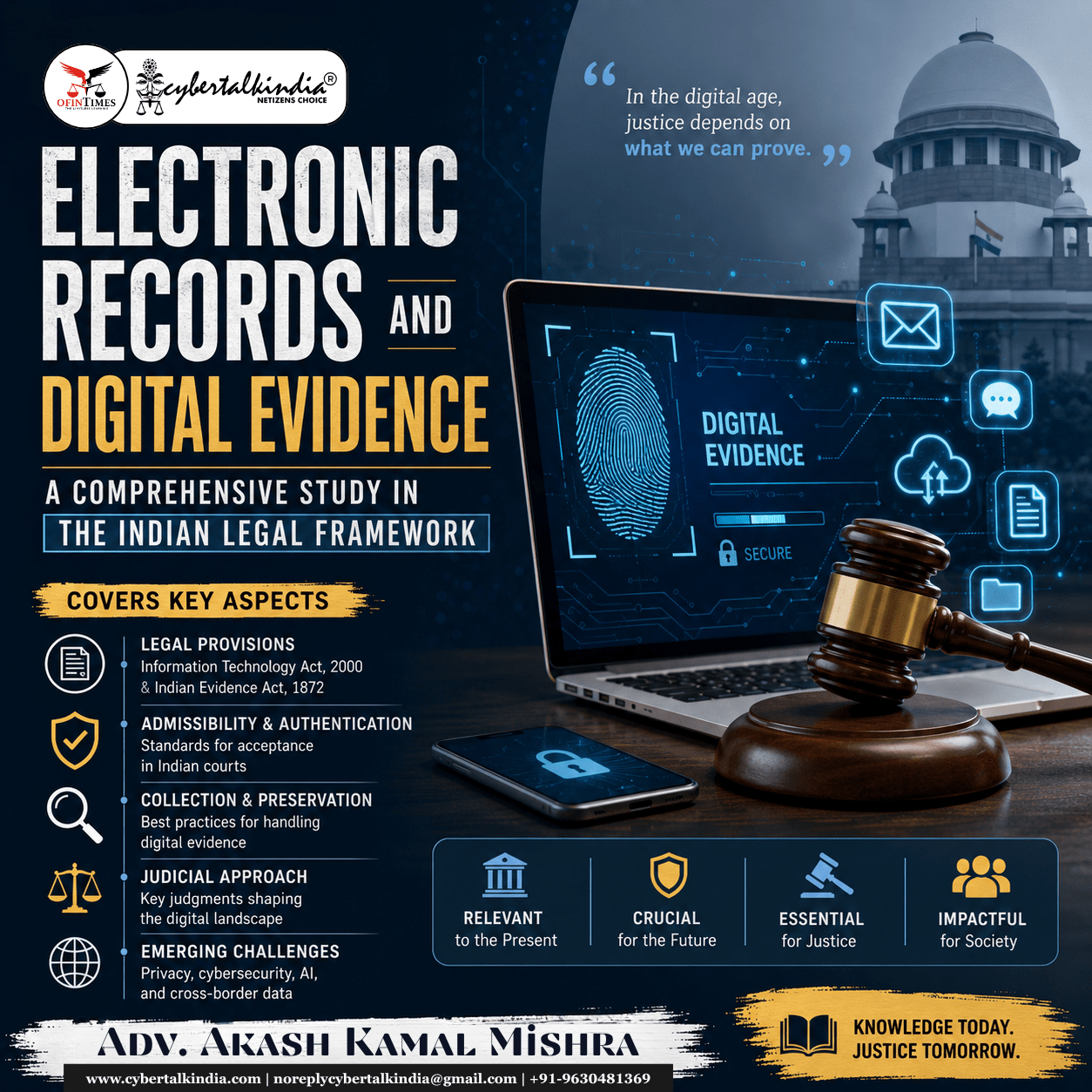
Electronic Records and Digital Evidence A Comprehensive Study in the Indian Legal Framework
- Introduction : The rapid advancement of information and communication technology has fundamentally transformed the manner in which individuals, businesses, and governments create, store, communicate, and preserve information. Traditional paper-based records have increasingly been replaced by electronic records, while digital communications have become the primary medium of interaction in contemporary society. Emails, electronic contracts, social media posts, text messages, cloud-stored documents, digital photographs, CCTV footage, biometric data, blockchain records, and online transactions now form an integral part of everyday life. Consequently, disputes and criminal investigations frequently involve evidence existing in electronic form. The legal recognition and admissibility of such evidence have therefore become critical issues in modern jurisprudence. Electronic records and digital evidence constitute the backbone of cyber law and digital justice systems, enabling courts and investigative agencies to determine facts and establish liability in an increasingly digital environment.
The legal framework governing electronic records and digital evidence in India has evolved significantly with the enactment of the Information Technology Act, 2000, and subsequent amendments to evidence laws. The recognition of electronic records as legally valid documents has facilitated e-governance, e-commerce, digital banking, and online dispute resolution. Simultaneously, courts have developed principles concerning the authenticity, reliability, integrity, and admissibility of electronic evidence. As cybercrimes continue to increase and digital technologies become more sophisticated, understanding the nature, evidentiary value, and legal treatment of electronic records has become indispensable for legal professionals, law students, policymakers, and law enforcement agencies.
- Meaning and Concept of Electronic Records : An electronic record refers to any information, data, record, image, sound, or information generated, sent, received, or stored in electronic form. Unlike traditional paper documents, electronic records exist in digital formats and can be transmitted instantly across geographical boundaries. The Information Technology Act, 2000 defines an electronic record broadly to include data generated, image or sound stored, received, or sent in electronic form, microfilm, and computer-generated microfiche.
Electronic records may include emails, electronic contracts, spreadsheets, databases, digital photographs, video recordings, instant messages, social media communications, websites, cloud-stored information, electronic logs, blockchain records, and digital signatures. The defining characteristic of an electronic record is that it exists in a machine-readable form and can be processed through computer systems or digital devices.
The recognition of electronic records has revolutionized commercial and governmental activities. Organizations now maintain digital archives rather than physical files. Government departments increasingly implement e-governance initiatives where records are generated and maintained electronically. Similarly, businesses rely upon electronic documentation for contracts, invoices, correspondence, and financial transactions. The legal acceptance of such records is therefore essential for ensuring certainty and efficiency in modern transactions.
- Legal Recognition of Electronic Records in India : The Information Technology Act, 2000 introduced legal recognition for electronic records in India. Section 4 of the Act provides that where any law requires information or any matter to be in writing or typewritten form, such requirement shall be deemed satisfied if the information is rendered or made available in an electronic form and is accessible for subsequent reference.
This provision establishes the principle of functional equivalence, whereby electronic records are accorded the same legal status as paper documents, provided they satisfy certain conditions of accessibility and reliability. The objective is to ensure that technological advancements are not hindered by outdated legal formalities requiring physical documentation.
Similarly, Section 5 of the Information Technology Act grants legal recognition to electronic signatures. This provision enables individuals and organizations to authenticate electronic records securely and facilitates electronic transactions. Electronic signatures serve functions analogous to handwritten signatures by indicating consent, approval, or authorship.
The combined effect of Sections 4 and 5 is that electronic records and electronic signatures are legally valid and enforceable, thereby promoting electronic commerce, digital governance, and online communication.
- Understanding Digital Evidence : Digital evidence refers to any information of probative value stored or transmitted in digital form that may be used in legal proceedings. It encompasses electronic records and data generated through digital devices, computer systems, networks, mobile phones, cloud environments, and internet platforms.
Digital evidence is often described as information and data stored on, received from, or transmitted by electronic devices that can establish facts relevant to a legal dispute or criminal investigation. It may be presented to prove the occurrence of a transaction, identify an offender, establish intent, verify communications, trace financial activities, or reconstruct events.
Unlike conventional evidence, digital evidence possesses unique characteristics. It is intangible, easily replicable, susceptible to alteration, and often requires specialized technical expertise for collection and analysis. These characteristics necessitate specific procedural safeguards to ensure reliability and admissibility.
- Types of Digital Evidence : Digital evidence exists in numerous forms depending upon the nature of the technology involved. Computer-based evidence includes documents, spreadsheets, databases, browsing histories, system logs, and deleted files recovered through forensic techniques. Mobile devices generate evidence such as call records, text messages, application data, GPS location information, photographs, and multimedia content.
Internet-based evidence includes emails, social media posts, online chats, website content, cloud-stored documents, and internet protocol (IP) logs. Financial evidence may include electronic fund transfer records, online banking transactions, cryptocurrency records, digital wallets, and electronic payment histories.
Video and surveillance evidence includes CCTV recordings, dashcam footage, body-worn camera recordings, and drone-generated data. Emerging technologies such as blockchain systems, artificial intelligence platforms, Internet of Things (IoT) devices, and smart contracts are generating new categories of digital evidence that courts increasingly encounter.
Each category presents unique challenges concerning authenticity, integrity, chain of custody, and forensic examination.
- Characteristics of Digital Evidence : Digital evidence possesses several distinctive characteristics that differentiate it from traditional documentary evidence. First, it is highly fragile and can be altered intentionally or accidentally without visible traces. A single modification may compromise evidentiary integrity and affect admissibility.
Second, digital evidence can be duplicated perfectly without degradation. Unlike photocopies of paper documents, digital copies can be exact replicas of the original. This characteristic creates challenges regarding identification of the original source and verification of authenticity.
Third, digital evidence often contains metadata, which refers to information about the data itself. Metadata may reveal the date and time of creation, modification history, device information, user details, geographical location, and transmission records. Such information frequently becomes crucial in investigations.
Fourth, digital evidence may be distributed across multiple locations and jurisdictions. Cloud computing technologies often store data across servers situated in different countries, raising complex questions of jurisdiction, access, and legal cooperation.
Finally, digital evidence requires specialized technical expertise for acquisition, preservation, examination, and presentation. Digital forensic experts play a vital role in ensuring that evidence remains reliable and legally admissible.
- Admissibility of Electronic Evidence under Indian Law : The admissibility of electronic evidence in India is governed primarily by the provisions of the Bharatiya Sakshya Adhiniyam, 2023, which replaced the Indian Evidence Act, 1872. The new legislation continues to recognize electronic and digital records as valid forms of evidence while adapting evidentiary principles to modern technological realities.
Electronic records are admissible when their authenticity and integrity can be established through legally recognized procedures. Courts generally require proof that the electronic record was generated, stored, and transmitted through reliable systems and has not been tampered with. The evidentiary value of electronic records depends upon the credibility of the source, the reliability of the system producing the record, and compliance with statutory requirements.
Judicial decisions have emphasized that electronic evidence must satisfy requirements relating to authenticity, accuracy, and reliability. The burden lies upon the party relying on electronic evidence to demonstrate its trustworthiness. Courts carefully scrutinize electronic evidence because of its susceptibility to manipulation and fabrication.
- Landmark Judicial Decisions on Electronic Evidence : Indian courts have played a significant role in developing the jurisprudence relating to electronic evidence. In *State (NCT of Delhi) v. Navjot Sandhu* (2005), commonly known as the Parliament Attack Case, the Supreme Court initially adopted a liberal approach toward the admissibility of electronic evidence.
However, the landmark judgment in Anvar P.V. v. P.K. Basheer fundamentally reshaped the legal position. The Supreme Court held that electronic evidence must comply with statutory requirements and that electronic records cannot be admitted merely through oral testimony when specific legal procedures are prescribed.
Subsequently, in Arjun Panditrao Khotkar v. Kailash Kushanrao Gorantyal, the Supreme Court clarified various aspects concerning electronic evidence and reaffirmed the importance of procedural compliance for admissibility. The Court emphasized that electronic records constitute a distinct category of evidence requiring specialized treatment under evidence law.
These judgments have become foundational authorities governing electronic evidence in India and continue to guide courts in resolving issues related to digital records.
- Digital Forensics and Investigation : Digital forensics is the scientific process of identifying, collecting, preserving, examining, analyzing, and presenting digital evidence. It aims to recover information from digital devices while maintaining evidentiary integrity and ensuring admissibility in legal proceedings.
The forensic process typically begins with evidence identification and preservation. Investigators secure devices and prevent unauthorized access or modification. Forensic imaging techniques create exact copies of storage media to avoid altering original evidence. Analysts then examine the copied data using specialized forensic tools to identify relevant information.
Digital forensic investigations often involve recovery of deleted files, examination of internet activity, analysis of communication records, identification of malware, tracing of cyberattacks, and reconstruction of digital events. Findings are documented comprehensively and presented through expert testimony in courts.
Digital forensics has become indispensable in investigating cybercrimes such as hacking, identity theft, phishing, online fraud, cyberstalking, ransomware attacks, data breaches, and digital financial crimes.
- Challenges Associated with Electronic Records and Digital Evidence : Despite technological advancements, significant challenges continue to affect the collection and use of digital evidence. One major challenge is data manipulation. Sophisticated software enables alteration of digital records without obvious indications, making authenticity verification difficult.
Another challenge involves encryption technologies. While encryption enhances privacy and security, it can hinder lawful investigations when access to data becomes technically difficult. Cloud computing presents additional challenges because evidence may be stored across multiple jurisdictions with differing legal frameworks.
Privacy concerns also arise during digital investigations. Investigators must balance evidentiary requirements against constitutional protections relating to privacy and personal liberty. Excessive surveillance or unauthorized access to personal data may violate fundamental rights.
The rapid evolution of technology further complicates matters. Legal frameworks often struggle to keep pace with emerging technologies such as artificial intelligence, blockchain systems, virtual reality environments, and decentralized networks. Courts and legislators must continually adapt legal principles to address these developments effectively.
- Importance of Electronic Records and Digital Evidence in Contemporary Society : Electronic records and digital evidence have become indispensable components of modern legal systems. They facilitate efficient administration, enable digital governance, support commercial transactions, and assist in combating cybercrime. Digital evidence frequently provides objective and detailed information that may not be available through traditional forms of evidence.
In criminal investigations, electronic evidence helps identify perpetrators, establish timelines, verify communications, and trace financial transactions. In civil disputes, electronic records support claims relating to contracts, intellectual property rights, employment matters, commercial transactions, and consumer protection. Government agencies rely on electronic records for regulatory compliance, public administration, and service delivery.
As societies continue to digitize, the importance of electronic records and digital evidence will only increase. Legal systems must therefore ensure robust frameworks for their recognition, preservation, authentication, and admissibility.
- Conclusion : Electronic records and digital evidence represent one of the most significant developments in modern legal practice. The transition from paper-based systems to digital environments has transformed the manner in which information is created, stored, communicated, and utilized. Recognizing this transformation, Indian law has granted legal validity to electronic records and developed specialized evidentiary principles governing their admissibility and reliability.
The Information Technology Act, 2000 and the Bharatiya Sakshya Adhiniyam, 2023 collectively provide the legal foundation for recognizing and utilizing electronic evidence. Judicial decisions have further clarified the standards required for admissibility, authenticity, and evidentiary value. At the same time, digital forensics has emerged as an essential discipline for investigating and preserving electronic evidence.
Although challenges relating to authenticity, privacy, cybersecurity, encryption, and technological evolution persist, electronic records and digital evidence remain indispensable to contemporary justice systems. Their significance will continue to expand as digital technologies become increasingly integrated into every aspect of human activity. For legal professionals and law students, a thorough understanding of electronic records and digital evidence is therefore essential for navigating the evolving landscape of cyber law and digital justice in the twenty-first century.
Tag: #electronicrecords #digitalevidence #cyberlaw #cyberlawindia #digitalforensics #electronicevidence #digitalevidencelaw #informationtechnologyact #bharatiyasakshyaadhiniyam #evidencelaw #lawstudents #legaleducation #lawschool #legalresearch #indianlaw #cybercrime #cybersecurity #dataprivacy #digitalrights #internetlaw #technologylaw #forensicinvestigation #digitalforensicsexpert #electronicdocuments #digitalinvestigation #legalstudies #legalawareness #lawarticle #lawblog #legalcontent #advocate #lawyerlife #judiciary #justice #legalupdate #legalknowledge #cybertalkindia #cyberawareness #cyberjurisprudence #onlineevidence #electroniccommunication #digitallaw #legalwriting #researcharticle #llmstudents #lawprofessor #futureoflaw #legaltech #cybereducation #india #trending #viral #explorepage #instalaw #linkedinlearning #legalcommunity #lawandtechnology #cybersecurityawareness #digitalindia #legalinsights